

The Clicks I Add

“We held our breath…”
That’s how Mandie described the moment she and my daughter-in-law lowered the stylus on a record they wanted to play while I wasn’t home. Mandie is an old pro now, but back then, cueing up a record for playback wasn’t something she felt comfortable with. On that long ago day, my daughter-in-law watched on, both of them sure that Mandie would do something wrong.
I get it. It can be intimidating. Especially when you hear enthusiasts talk about record care, storage tips, cleaning, stylus wear, etc. I am constantly researching and learning about this thing that I love.
Life today, especially when it comes to technology, is about removing steps. The fewer clicks it takes to do something the better. Amazon has one-click ordering. Friction in any process is bad. Walk into any organization and say “process improvement” and everyone will know what you are talking about. Any friction in a hobby is studied and analyzed by “experts” dedicated to smoothing it out or removing it altogether.
This is our culture. Why be bothered with four clicks when another service lets you do it in two?
Is friction a bad thing? If you asked a cyclist about the efforts they go through to check tire pressure, lube the chain, or make adjustments, would they complain that they are annoyed by these things? No. A guitarist who tries different gauge strings, changes them, tunes them, and maybe even waxes them, does so without dread or irritation. It’s just part of doing the thing. The friction is part of the practice. It’s a learned skill.
When I check the tracking force, reset antiskate, or clean the stylus, it’s not inconvenient. It’s a skill I’ve learned over the years. I understand it and I’m fairly good at it. And I’m still learning. I tweak my record-cleaning process constantly. When I tweak it, the result is usually more steps, not fewer. I’m adding “clicks” to the process, not removing them.
For me, and many others, the vinyl playback experience involves the accumulation of skills. Nobody says, “Hey, you’re good at vinyl!” but those of us engaged with it understand that, in a real sense, we are. Flipping a record to play the next side is done without a moment’s thought, as is removing it from its sleeve without touching the surface. Muscle memory does this for me. When I squirt a Citranox mixture on a record and brush it into the groove, I do so on auto-pilot.
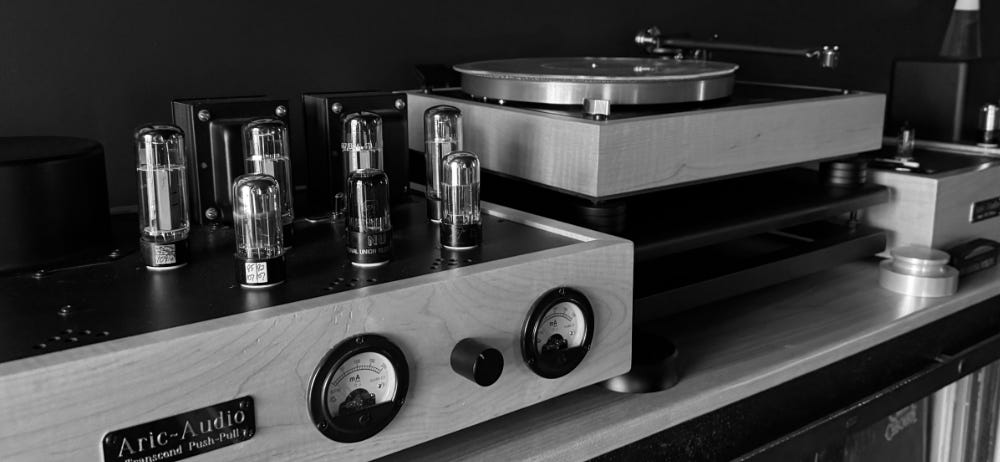
There is something satisfying in being skilled at something you love. Having these skills changes how I listen and interact with the music I enjoy. All the little friction points in the vinyl playback experience are worth it when I lower the stylus, observe the tiniest crackle that quickly recedes, and hear the first notes of “More Than a Feeling.” I helped bring it to life. I curated the system, selected the tubes, and did everything I could to fill the room with the sounds and practices that made me who I am.

The Needle Drop

L.A. Woman has been and will always be my favorite album by the Doors. It’s bluesy, raw, and different from every album that came before it. It was also their last album. Jim Morrison within three months after it’s release in 1971. He sounds much older than his 27 years. You’ll hear some radio hits, such as the title track, “Rider on the Storm” and “Lover Her Madly”, but it’s the deeper tracks which pull me in. “Been Down So Long” and “Hyacinth House” are personal faves. It’s one of those records I’ll never get enough of.

Around the Groove
Mandie Fixes My Album Cover
It’s inevitable that after decades of collecting records there will be a handful with split seams. When I was a teenager, my go-to was tape. It was effective, looked awful, and is impossible to remove for a better solution.
Today, thankfully, I have Mandie to expertly transform a seam-split into something as good as new. She shows us how she does it in the video below.
